
✨ This article was AI edited. Editorial responsibility: ChrisberGen.Blog.
Produced with AI. This article was artificially generated. Editorial responsibility: ChrisberGen.Blog.
The role of enterprise supply chain leadership has experienced a permanent paradigm shift. For decades, supply chain management was treated as a cost center focused narrowly on just-in-time (JIT) optimization, margin shaving, and single-source procurement. However, global geopolitical volatility, supplier insolvencies, and acute logistics bottlenecks have demonstrated that extreme lean efficiency without structural resilience is catastrophic. Today’s supply leader operates as an enterprise strategist—orchestrating technology, contracts, and talent into an adaptable network.
1. The Four Pillars of Modern Supply Chain Leadership
Modern supply leadership requires balancing operational discipline with forward-looking risk mitigation across four core pillars:
Pillar 1: Multi-Tier Visibility & Real-Time Telemetry
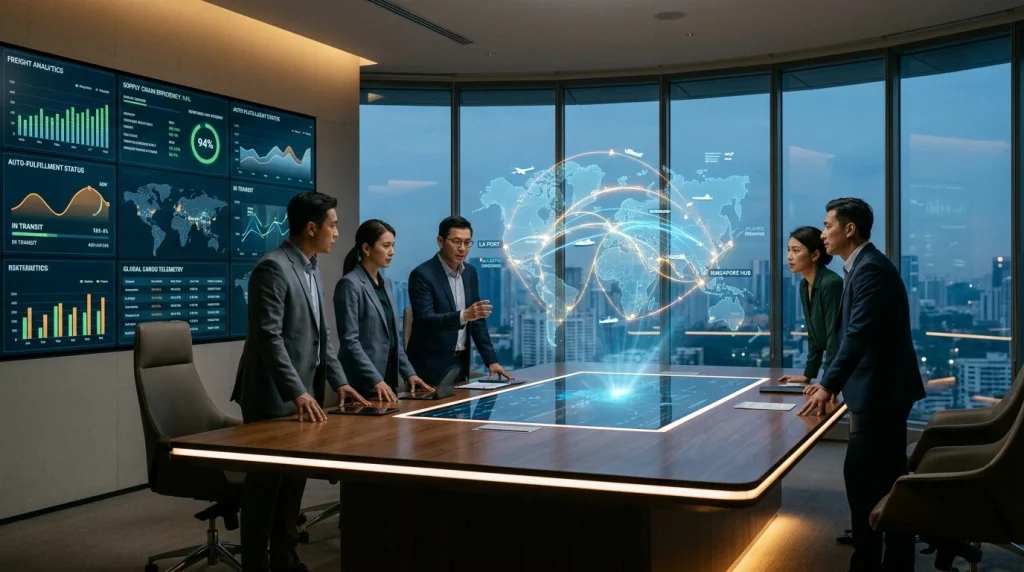
Traditional visibility ended at Tier-1 direct suppliers. Modern supply leaders deploy tracking architectures that penetrate into Tier-2 raw material processors and Tier-3 sub-component fabricators. Knowing that a secondary component fabricator faces an environmental shutdown three weeks before the delivery date transforms a catastrophic production stop into an orderly inventory reroute.
Pillar 2: Strategic Dual-Sourcing and Regionalization
Relying on a single low-cost manufacturer across an ocean is no longer acceptable governance. Exemplary leaders employ a “China + 1” or nearshoring framework, retaining primary volume production in cost-effective regions while maintaining qualified, live secondary manufacturing capacity closer to core consumer markets.
Pillar 3: Data-Driven Demand Modeling vs. Bullwhip Amplification
The bullwhip effect—where minor shifts in retail consumer demand amplify into severe over-ordering upstream—plagues uncoordinated networks. Supply leaders connect point-of-sale data streams directly to ERP procurement engines, utilizing statistical smoothing and machine-learning forecasting rather than intuitive batch ordering.
Pillar 4: Sustainable and Regulatory Governance (ESG & Scope 3)
Regulatory frameworks, such as the EU Corporate Sustainability Due Diligence Directive and international carbon accounting standards, mandate strict tracking of emissions and ethical labor throughout upstream channels. Modern leadership embeds auditability directly into supplier qualification scoring.
2. Strategic Framework: Lean Efficiency vs. Network Resilience
A supply leader must navigate the fundamental trade-off between capital tied up in safety stock and the enterprise cost of stockouts. Review the structural divergence between legacy lean models and resilient architectures:
| Operational Dimension | Legacy Lean (JIT) Focus | Resilient Strategic Leadership |
|---|---|---|
| Supplier Footprint | Single-source for maximum volume discount | Diversified multi-sourcing with capacity reservations |
| Inventory Strategy | Zero buffer stock; micro-deliveries | Decoupled strategic buffers on critical path components |
| Contract Architecture | Transactional, fixed-price RFPs | Partnership agreements with indexed cost sharing |
| Information Architecture | Siloed batch EDI spreadsheets | API integrations, live IoT freight telematics, ERP webhooks |
| Key Performance Metric | Unit Purchase Price (PPV) | Total Cost of Ownership (TCO) & On-Time-In-Full (OTIF) |
3. Core Technology Stack for Enterprise Supply Leaders
Operational agility requires robust software infrastructure. Leading organizations integrate modern platform tools across several layers:
- Enterprise Resource Planning (ERP): SAP S/4HANA, Oracle NetSuite, or Microsoft Dynamics 365 providing the unified transactional backbone.
- Transportation Management Systems (TMS): Automated routing engines that dynamically balance freight rates across LTL, FTL, intermodal, and air cargo based on fluctuating fuel surcharges.
- Warehouse Automation & Robotics (WMS): Automated storage and retrieval systems (ASRS) paired with barcode/RFID telemetry that minimize picker cycle times and eliminate inventory drift.
- Supplier Collaboration Platforms: Dedicated partner portals that enable suppliers to view rolling 12-month demand forecasts, upload compliance documentation, and acknowledge purchase orders electronically.
4. Managing Cultural Transformation and Talent Retention
Technology and supplier contracts are only as effective as the human teams managing them. An exceptional supply leader fosters cross-functional alignment between procurement, engineering, sales, and executive finance:
- Bridging Procurement and Engineering: Involve supply chain specialists during initial product design phases to ensure specified components are readily available from multiple qualified manufacturers, avoiding single-source engineering traps.
- Aligning Sales and Operations Planning (S&OP): Implement monthly executive governance meetings where commercial sales projections are reconciled against factory production capacity and logistics constraints.
- Empowering Decentralized Decision-Making: Provide plant-level procurement managers with predefined financial thresholds to approve alternative air freight or expedited tooling during emergencies without waiting for corporate sign-off.
5. Executive Action Plan: Establishing True Operational Resilience
To audit and fortify your enterprise supply chain over the next quarter, implement this structured roadmap:
- Phase 1: Critical Dependency Audit. Identify the top 20% of SKUs generating 80% of revenue. Map every component back to raw materials, identifying any single-source dependencies.
- Phase 2: Stress-Testing Lead Times. Model scenario impacts if primary shipping lanes face 30-day maritime delays or critical suppliers face regional power outages.
- Phase 3: Contractual Resilience Clauses. Renegotiate key supplier agreements to include mandatory disaster recovery provisions and priority allocation terms during global shortages.
- Phase 4: Telemetry Integration. Connect freight tracking APIs directly into customer portal interfaces, ensuring transparency before delays impact client operations.
Get our latest guides, news, and insights highlighted in your Google Search & AI Overviews.