
✨ This article was AI edited. Editorial responsibility: ChrisberGen.Blog.
Produced with AI. This article was artificially generated. Editorial responsibility: ChrisberGen.Blog.
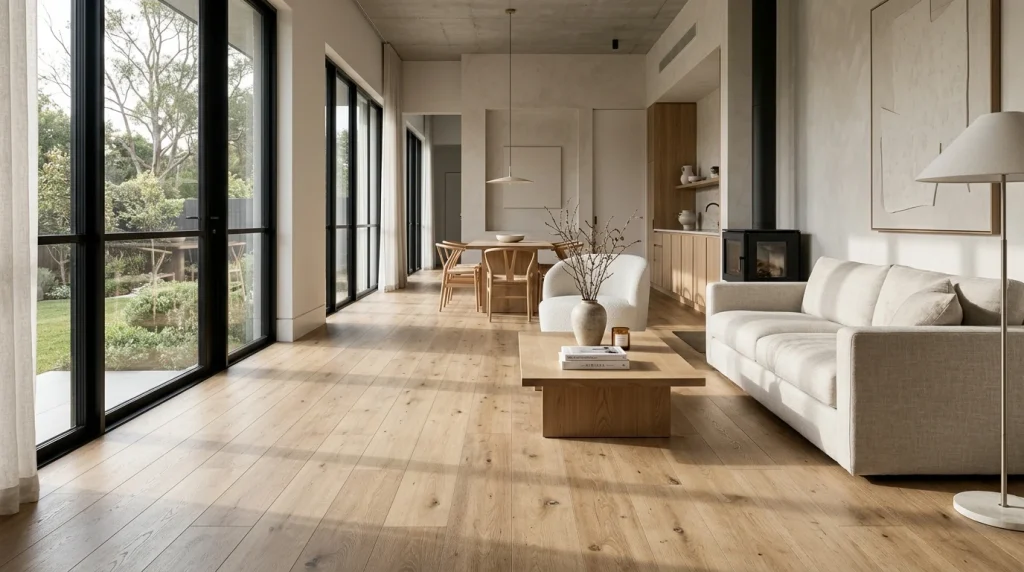
Few flooring materials have sparked as much debate among homeowners, interior designers, and property managers as Luxury Vinyl Plank (LVP). Once dismissed as merely a glorified version of 1970s sheet linoleum, LVP has evolved into a dominant category in the residential and commercial flooring markets. Yet, prospective buyers still frequently ask: does LVP look cheap? The honest answer is nuanced: low-grade builder-basic vinyl undeniably looks synthetic, but commercial-grade, rigid-core luxury vinyl often challenges even seasoned contractors to tell it apart from real hardwood.
1. What Makes Cheap Vinyl Look “Cheap”?
When people critique vinyl flooring as looking low-rent or artificial, they are usually identifying specific manufacturing shortcuts common to entry-level budget products:
- Repetitive Pattern Printing: Low-cost vinyl repeats the exact same wood grain image every 3 to 5 planks. When installed across an open-concept living area, the eye immediately catches “twin planks” and identical knot clusters, destroying any illusion of organic timber.
- Artificial High Sheen: Cheap vinyl uses basic gloss finishes that reflect direct ceiling light harshly, creating an oily or plastic appearance. Real oiled or wire-brushed hardwood absorbs and diffuses light softly.
- Flat Printed Textures: Budget products use generic roller embossing that does not match the printed grain beneath it. If you run your hand across a knot and feel a smooth surface, or feel grain lines running perpendicular to the visual grain, the human brain instantly flags it as fake.
- Square, Seamless Edges: Without micro-bevels or painted accent bevels, planks butt together into a continuous plastic sheet, lacking the subtle individual shadow lines that define natural plank installations.
- Telegraphing Subfloor Imperfections: When flexible LVT is laid over an uneven concrete slab without proper self-leveling compound, every ridge, screw head, and hollow spot projects upward through the plank surface.
2. The Hallmarks of High-End, Indistinguishable LVP
If you want LVP that commands respect and elevates property valuation, prioritize specifications engineered to eliminate synthetic cues:
A. Embossed-in-Register (EIR) Technology
EIR is the gold standard of modern resilient flooring. The mechanical embossing plates are laser-synchronized with the digital decorative film. Every knot, grain split, and cathedral arc has matching tactile depth, meaning the texture you feel corresponds exactly with the wood grain you see.
B. Rigid Core Construction (SPC vs. WPC)
Stone Plastic Composite (SPC) uses a dense limestone-powder core that delivers rock-solid dimensional stability and resists heavy indentation from furniture legs. Wood Plastic Composite (WPC) introduces foaming agents that create a warmer, softer step underfoot. Both rigid-core variants eliminate the flimsy flexibility of traditional glue-down vinyl.
C. Ultra-Matte Urethane Coatings with Ceramic Bead Additives
High-end architectural collections apply multi-layer cured urethane finishes with gloss levels below 7%. This produces a natural low-sheen satin finish identical to high-end European white oak treated with hard-wax oil.
3. Detailed Comparison: Hardwood vs. Engineered Wood vs. Premium LVP
Evaluate the material trade-offs across aesthetic realism, maintenance burden, and long-term durability:
| Feature / Spec | Solid Hardwood | Engineered Hardwood | Premium Rigid LVP (SPC) |
|---|---|---|---|
| Visual Authenticity | 100% Organic, zero repeats | Real timber veneer layer | High (EIR 10–12 plank repeats) |
| Water Resistance | Vulnerable to warping/cupping | Moderate surface water resistance | 100% Waterproof core |
| Scratch & Pet Durability | Dents from dog claws/high heels | Veneer can scratch to core | 20+ mil wear layer impervious |
| Average Material Cost | $8.00 – $18.00 / sq. ft. | $6.00 – $14.00 / sq. ft. | $3.50 – $7.00 / sq. ft. |
| Refinishability | Can sand & stain 4–6 times | 1–2 sandings depending on veneer | Cannot be sanded or refinished |
4. The Crucial Role of Installation in Aesthetic Perception
Even a $9/sq. ft. premium commercial vinyl plank will look cheap if improperly installed. Professional installation makes or breaks the appearance:
- Staggered Seams (Random Racking): Never install planks in an “H-pattern” or stair-step repeat where end seams align every second or third row. Maintain at least 8 to 12 inches between end joints across adjacent rows to mimic natural random-length timber.
- Subfloor Preparation: The subfloor must meet strict flatness tolerances (typically within 3/16 inch over a 10-foot radius). Grind down high concrete ridges and fill low pockets with polymer-modified cement. A flat floor eliminates the hollow clicking sound when walking.
- Transition Strips and Baseboards: Cheap installations use chunky T-molding strips across doorways. Premium installations pull baseboards, run continuous planks through door headers without thresholds (within manufacturer run limits), and tuck plank expansion gaps cleanly beneath 5-inch baseboards and shoe moulding.
- Underlayment Density: If the plank does not include an attached acoustic pad, invest in high-density IXPE (cross-linked polyethylene) underlayment. Low-grade soft foam creates a bouncy “trampoline” feel that instantly reveals synthetic construction.
5. The Verdict: When Should You Choose LVP?
LVP is the optimal architectural selection for busy family households, pet owners, rental investment properties, basements, and humid climates where solid hardwood would fail. As long as you select an SPC plank with at least a 20 mil wear layer, EIR grain alignment, matte finish, and deep painted bevels, your floor will look luxurious, timeless, and completely natural.
Get our latest guides, news, and insights highlighted in your Google Search & AI Overviews.